Naughty Krishna holding a piece of candy

Did you know that men have worries? I didn’t either till I read about it on MSN. Yeah. Men worry about things like loneliness, difficulty making friends, being seen as weak or unmanly or maybe even violent.
And old people have their problems too, but I knew that. They yearn for their lost youth and lost beauty, they lament their bodily weakness, and and they fear their impending death.
But I am a man, and I am old. How come I don’t worry about these things too?
So I went to ask my therapist. Or maybe I should say therapists. I have three of them.
And they live nearby, in my living room, on the altar. Here’s their picture.
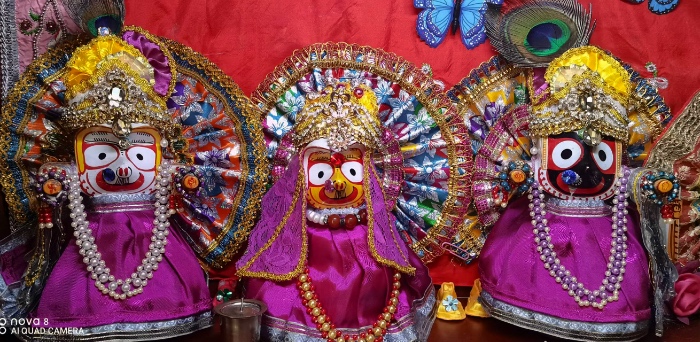
Let me introduce them.
On the right, stands Jagannath, the one with the complexion like a black raincloud. His name joins two Sanskrit words: jagan, “universe” and nath, “lord.” So Jagannath means “Lord of the universe.” It counts among Krishna’s many names. He is the same Krishna who spoke the Bhavagad-Gita to Arjuna.
On the left, with a complexion white as pure milk, stands Baladeva, Krishna’s big brother (also known as Balarama). He killed the false teacher Romaharshan with just a blade of tall grass. An incarnation of Krishna, he deserves our worship.
Between them, shining like gold, stands their younger sister Subhadra, the spiritual counterpart of Maya, the deluding energy.
But why do I call them my therapists?
Well, whenever doubts fill my mind and I feel sorry for myself and I lament my cruel fate, I walk over to my altar and look at Jagannath, Baladeva, and Subhadra.
Will they help me?
But before I even have time to ask , their beauty evaporates the doubts from my mind the way the sunlight evaporates the smell of a musty room.
What Kind of Beauty?
“Beauty?” you ask. “But they look so strange. Why do they look that way?”
Well, for one, they are copies of originals that remain unfinished. Srila Prabhupada explains (lightly edited for readability):

But [the Jagannath Temple] is, according to our calculation, more than three thousand years old. So this King Indradyumna asked Visvakarma [the architect of the gods] to carve the deities of Krsna, Balarama, and Subhadra. And there was a time limit. Visvakarma made an agreement that ‘[Until] I finish the deities’ carving very nicely, you cannot [come to] see me.’
So the door was closed, and the king was very much anxious to see the temple established very soon. So he forcibly opened the door, and he saw that the deities were half finished. The deity Jagannatha as you see, appears half finished.The king decided, ‘Never mind if they are half finished. I shall install these deities in the temple.’
Since then, the three deities—Jagannatha, Balarama and Subhadra—are being worshiped in India at Jagannatha Puri.” (San Francisco July 4, 1970)

My godbrother Satyaraja Das elaborates in his essay “Lord Jagannath: Krishna as an Unstoppable Force”:
[Background: King Indradyumna is disappointed because in spite of an arduous journey he has not been able to visit the Deity named Nila Madhava.]
The Deity had been moved. At that point, the King’s life lost meaning: Like the yogi-king that he was, he decided to fast until death.
But the Lord would not have it. He appeared to Indradyumna in a dream, insisting that his lamentation was needless— ‘Build a large temple for Me on top of Nila Hill in Puri. There you will see Me, not as Nila-Madhava, but in a form made of wood.’
God Himself promised to appear as wood (daru), and thus, in Puri, He is called daru-brahma (‘wood-spirit’).
In due course, Indradyumna waited by Puri’s ocean, at the Bay of Bengal, where the Lord soon presented Himself as a giant log floating toward the beach. When the massive wooden cylinder arrived, the King appointed Visvakarma, architect of the gods, to do the needful.
But the eccentric Visvakarma gave him a stipulation: he would only carve the Deity if he could remain undisturbed for twenty-one days (although, according to some, it was fifteen days). If anyone were to interrupt him before that allotted time, he said, he would simply leave, even if his work had remained unfinished.
The King consented, and the divine carpenter toiled behind closed doors.
After some time, however, Indradyumna’s curiosity got the better of him, though some say it was Queen Gundicha, his wife, who could wait no longer.
Whatever the case, the royal doors were flung open, and Visvakarma, true to his word, had disappeared from the room. In his place were three unfinished Deities: Jagannath, Baladeva, and Subhadra, i.e., Krishna, the Supreme Lord; His brother Balarama (an alternate name for Baladeva); and His sister Yogamaya.
They had no hands or feet—and they didn’t look like Krishna, Vishnu, or any divinity with whom Indradyumna was familiar.
Still, because both Indradyumna and the sculptor had exhibited passion (raga) and divine love (prema) for the Deity, and because they both had the proper conception (bhava), which allowed for the flow of devotion (bhakti), the Lord agreed to fully manifest in the unfinished Deities.
Why the Big Eyes?
And more specifically, why do they have these expressions? Why the wide-opened eyes and the big smiles? Why the shortened arms?
Satyaraja Das explains in the same essay:
The narrative is told in various ways. The most common might be rendered as follows: Once, Rohini Devī, the mother of Lord Balarama, came to Dvaraka, and Krishna’s many wives took the opportunity to gather around and ask about His time in Vrindavan, which occurred long before His married life in Dvaraka.
. . . ‘How special are those residents of Vraja! Please tell us everything about them.’
Seeing their love for Krishna, Mother Rohiṇī agreed to describe His wonderful pastimes for them. But she stipulated that Krishna and Balarama should not hear these talks under any circumstances, lest They become unnecessarily self-conscious.
She suggested that she meet with the other queens when the two divine brothers are not in proximity. And so, one day when Krishna and Balarama were busy with other concerns, all the queens gathered in a huge lecture hall, anxious to hear Mother Rohini revel in Krishna’s Vrindavan pastimes.
This she did, but not before instructing Subhadra to keep guard at the front door, to make sure that Krishna and Balarama do not come back unexpectedly and perchance overhear their discussion.
As Mother Rohini rapturously communicated the childhood pastimes of Krishna, the queens listened with full attention, never once becoming distracted from the nectar that engulfed their ears.
Even Subhadra, who was at the door, became completely absorbed in hearing the narration, and though she tried to be conscientious about the task given to her, she found that after some time, she had failed: Krishna and Balarama suddenly appeared, standing directly in her midst.
No matter. The three of Them found Themselves ecstatically engrossed in Mother Rohiṇī’s words, and mystical transformations began to transform Them into unrecognizable beings. Their eyes became oversized and dilated; Their hands and legs withdrew into Their bodies. They became Jagannath, Balarama, and Subhadra as They now appear in Puri.
While They were exhibiting these ecstatic forms, the great sage Narada Muni appeared. Overwhelmed and delighted to witness these new manifestations, he approached Them with great love.
Acknowledging Narada’s presence, Krishna, along with His brother and sister, came to Their senses, thus resuming Their usual appearance.
Narada was initially speechless but then managed to speak, begging the Lord to again appear in this special form somewhere — anywhere — so that others could benefit from seeing it on a regular basis. This [special form], said Narada, should be seen by one and all.
To fulfill the desire of His pure devotee, Narada Muni, Lord Krishna manifested this form in Sri Ksetra, Purusottama Dhama, Jagannath Puri, where He resides to this day
Here Is the Secret
Narada Muni: A great devotee and associate of Krishna, often mentioned in the scriptures. He found the forms of Jagannath, Baladeva, and Subhadra to be not strange but wonderful. He wanted the whole world to see them.
Lord Chaitanya: Krishna himself feeling the emotions and showing the outward features of a devotee. When he saw Jagannath, Baladeva, and Subhadra in the temple at Puri, his ecstasy was so great that he fainted.
Here then, is the secret: Do you want to see the special beauty of Jagannath, Baladeva, and Subhadra? Then worship them. Follow in the footsteps of Narada Muni and Lord Chaitanya. Guaranteed: Jagannath, Baladeva, and Subhadra won’t disappoint you. I promise.
But perhaps you have doubts. Have others disappointed you? Of course. Do you ever feel sorry for yourself? Of course. Do you sometimes lament your cruel fate? Of course.
May I recommend my therapists?
⁓Umapati Swami, October 2, 2023
Eternally touching my head to the floor at the lotus feet of my spiritual master, Srila Prabhupada, for showing me all this.

(Note: The opinions expressed in this article are my own and do not necessarily reflect the opinions of any organization or any other person.)
Photo top: Naughty Krishna holding a piece of candy (Jishnu Das)
Write to me: hoswami@yahoo.com
© Umapati Swami 2023
Prabhupada quotation © Bhaktivedanta Book Trust
“Lord Jagannath: Krishna as an Unstoppable Force” © Steven J. Rosen

Srila Prabhupada
His Divine Grace A.C. Bhaktivedanta Swami Prabhupada is the teacher who brought Krishna Consciousness from India to the West and then to the rest of the world. He is the founder of the worldwide Hare Krishna Movement as well as the author and compiler of many works of Vedic knowledge. He left this world in 1977.

Umapati Swami
One of the first American devotees of the Hare Krishna Movement, he became Srila Prabhupada’s disciple in 1966. Since then, he has preached Krishna Consciousness in many countries and is the author of “My Days with Prabhupada,” available from Amazon. Now 86 years old, he has started this blog to share what he has learned.

 Umapati Swami's Blog